About
We built the firm we wish we'd hired.
We've been the ones let down by software that overpromised and pitches built for someone else. Alchemy Agentic is the response.
The argument
We've watched capable organizations buy a slick demo and inherit a mess. The technology was rarely the problem — the thinking underneath it never happened. So we flipped the order: get clear on what AI is actually for in your world, then build only what earns it.
Clarity first. Build second. The tool serves the goal — never the other way around.
Teammates again
"Our lockers were a few feet apart. Langtry. Norton. Alphabetical. Almost thirty years later, we're teammates again."
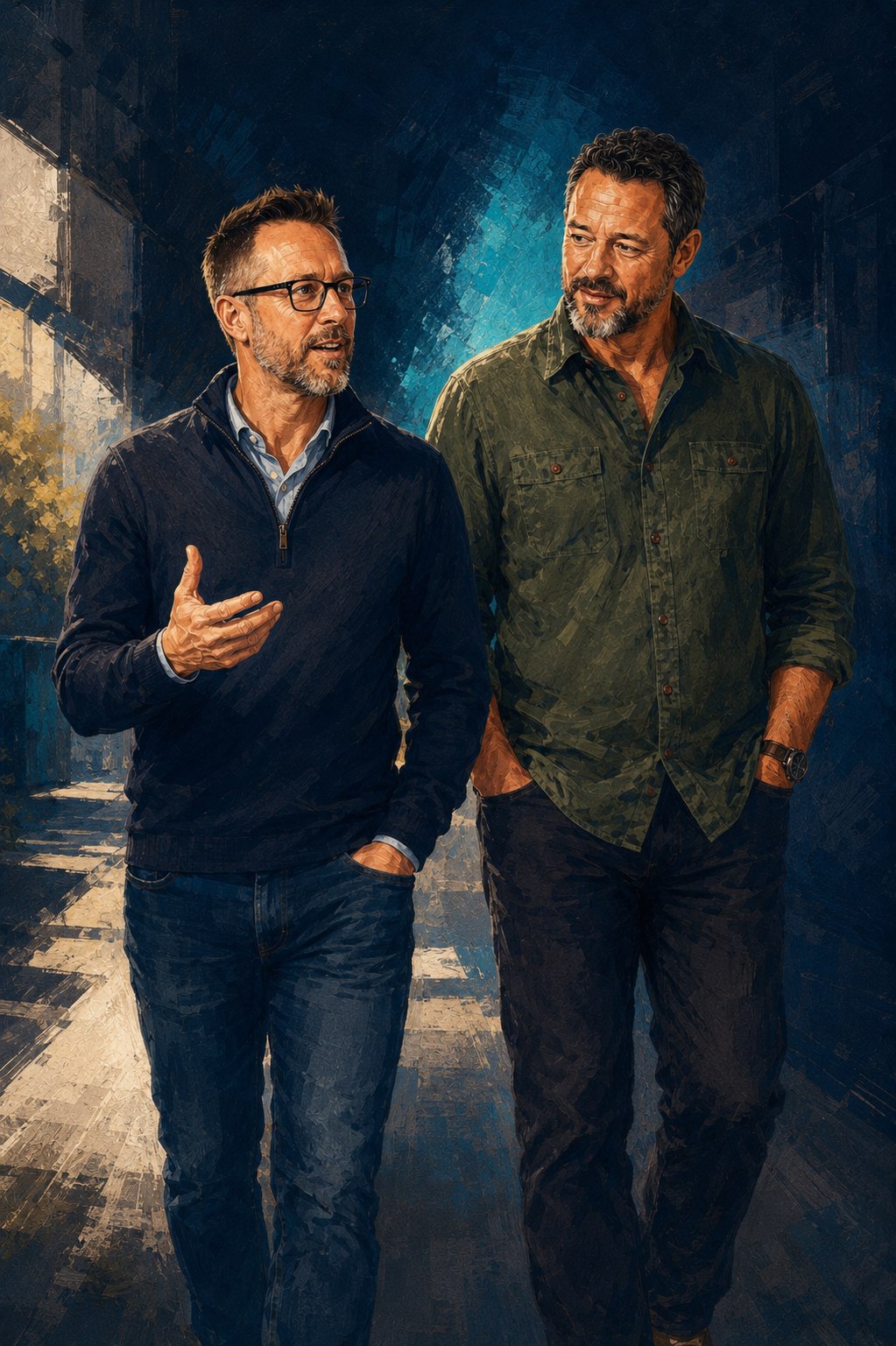
We met in 1997 on the men's lacrosse team at Rutgers, playing for Hall of Fame coach Tom Hayes. One of us went deep on the technology; the other went deep on the people. Both of us spent the next twenty-five years learning why projects really succeed or fail — and it was rarely the part everyone was looking at.
Two kinds of knowledge
Keith writes the on-ramps. Paul writes the depth.
Most engagements involve both questions, which is why we work as a pair.

The "so what."
I help people and organizations figure out what to actually do with AI — without making them feel like they need a computer science degree to keep up. 25+ years in higher-education advancement (Rutgers, Fordham, Stanford, USC) taught me that fundraising is really storytelling and listening. Along the way, I personally raised $175MM for a host of campus priorities and was a key contributor at world-class institutions in multiple capital campaigns that raised over $14.5B. Voice acting taught me the same thing in a different room.

The depth.
I bring 25+ years of enterprise rigor to the technical side — architecture, integrations, and the judgment of what's actually worth building. Most of it was at Adobe, leading a small embedded team the sales organization called "black ops": 90-day takeovers for clients like the NFL, Salesforce, Johnson & Johnson, and Zappos. I work the gap between strategy and engineering, where most AI projects quietly fail — impressive demos that break in production, tool sprawl no one can maintain. Technology-agnostic and workflow-first, I optimize for fewer moving parts and systems that hold up, starting with the question every client hears on day one: "Do you need that?"
The combination
Two careers spent learning why projects really succeed — or quietly fall apart.
The specifics — the enterprises, the campaigns, the institutions — live in our bios and on LinkedIn. Keith · Paul